Project management strategic waste separation plan for Haarlem

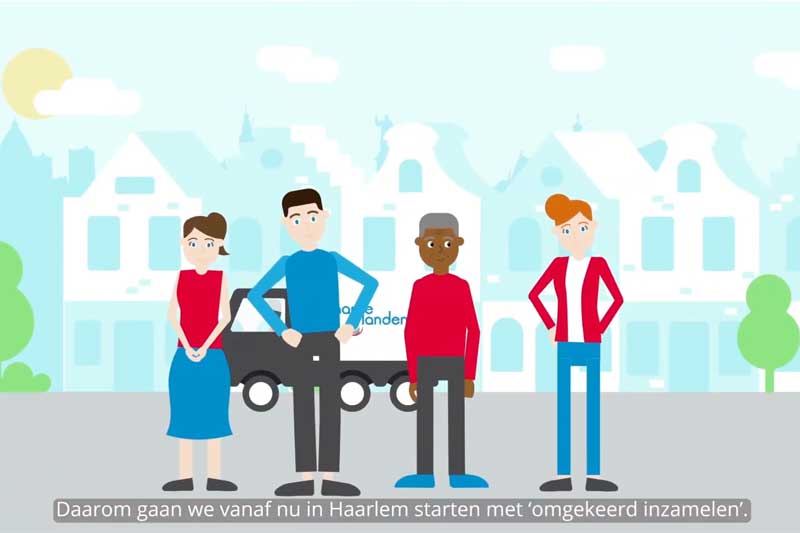
Management of a team at Spaarnelanden that was realizing the implementation of a new strategy for reversed waste collection to improve waste separation among residents in the municipality of Haarlem.

2017 - 2018

Inquiry

Management of a team at Spaarnelanden that was realizing the implementation of a new strategy for reversed waste collection to improve waste separation among residents in the municipality of Haarlem.

Approach

The focus was on improving service through new infrastructure, communication, and compliance enforcement to encourage better recycling and discourage residual waste in various housing types, including high-rise buildings, stacked housing, and low-rise buildings. Collective residual waste containers replaced the housecotainers.

oneindig duurzaam Loopwise

Our commitment includes

Rolling out new infrastructure first in three starting neighborhoods.

Low-rise homes were equipped with dual containers for paper and PMD (plastic, cans, and drink cartons). In high-rise neighborhoods, various residual waste containers were converted to PMD, paper, or organic waste containers. Some residual waste containers were also placed further away. Additionally, organic waste roll containers were set up on the street.

Implementing improvements in the starting neighborhoods and managing the roll-out citywide, including creating ‘raw material lanes’ based on resident input.

At three locations, residual waste was reintroduced, and above-ground resource containers were added to allow residents to dispose of both their residual waste and resources nearby. This ensures that resource containers contain less contamination due to the further distance of residual waste containers.

Development of communication strategies.

Communication activities

Deploy waste management coaches and engaging in community-based communication activities to inform and motivate residents to separate waste.

Enforcement strategy

Implementation of a new enforcement strategy in collaboration with waste management coaches.

Design and guidance of research.

Structuring and guiding research into whether pay-as-you-throw schemes (diftar) add value in a large city, based on benchmarks with other large cities.

Research on source separation

Researching differences between source separation and post-separation of plastic, drink cartons and cans.

Outcome

Three key influencing factors for waste policy were implemented, positively impacting waste separation:
- Service: Providing collection means that align with the housing types and residents' preferences.
- Communication/Participation: Motivating residents to separate waste and informing them on proper disposal methods and outcomes. Engaged residents, such as resource street adopters, contribute to improving waste separation.
- Compliance enforcement: Necessary for addressing poor separation behavior; residents also indicated that enforcement is needed to achieve better waste separation.

Website
www.spaarnelanden.nl

oneindig duurzaam Loopwise